Starting a Side Business in 2026: What Nobody Tells You
Starting a Side Business in 2026: What Nobody Tells You
I started my first side business while working full-time at a nonprofit I'd founded. Then I had kids. Life got complicated. And somehow, in the middle of managing a full household and a career as a systems consultant and keynote speaker (MyMensana), I built two more businesses: a curated dropshipping boutique (Era Luxe Boutique) and a platform empowering women entrepreneurs (Women Who Launch).
Nobody tells you it's going to look like this. Nobody warns you about the unglamorous parts, the ones that don't make it into the Instagram highlight reels or the "I quit my 9-5!" LinkedIn posts.
So let me tell you what starting a side business in 2026 actually looks like. Not the sanitized version. The real one.
The Truth About "Passive Income"
Let's get this out of the way first: passive income isn't passive.
I run a curated dropshipping boutique (Era Luxe Boutique), a platform empowering women entrepreneurs (Women Who Launch), and work as a systems consultant and keynote speaker (MyMensana). People see multiple income streams and assume I'm sipping margaritas while the money rolls in. What they don't see is the work I've put into building systems that actually function, the months I spent testing platforms, the countless hours I wasted on tools that promised automation but delivered headaches.
"Passive income" is what happens after you've built systems that work. It's not about working around the clock, it's about working smart enough that your business can function while you're managing medical appointments, raising kids, and actually living your life. But getting to that point? That requires figuring out what works and ruthlessly eliminating what doesn't.
And here's what nobody tells you: you will waste an ungodly amount of time, energy, and money on the wrong tools before you find the right ones. I've tried platforms that promised to "automate everything" and delivered nothing but broken integrations. I've paid for apps I used once. I've rebuilt entire systems because I chose the wrong foundation.
That's why Women Who Launch exists, so other women don't have to learn these lessons the expensive way. I've already made the mistakes. I've already wasted the money. Let me save you some of both.
If you're starting a side business hoping to get rich quick, I'm going to save you some time and disappointment: close this tab and go buy a lottery ticket instead. Your odds are about the same.
But if you're willing to show up consistently, even when it's boring, even when nobody's watching, even when the results take longer than you expected? Then keep reading.
Nobody Cares About Your Business (At First)
This one stings, but it's important: in the beginning, you will be shouting into the void.
I published my first 20 blog posts to an audience of exactly zero people. Not "a small audience." Not "just my mom and my best friend." Zero. My Google Analytics dashboard was so depressingly empty I stopped checking it.
The gurus selling you courses won't tell you this part. They'll show you their six-figure launch screenshots and make it sound like if you just follow their formula, success is inevitable and immediate. But here's what they won't say: they already had an audience when they launched. They already had credibility. They already had momentum.
You don't.
And that's not a failure. It's just reality. Everyone who's "made it" started at zero. The difference is that they kept going when it felt pointless.
I remember the first time someone I didn't know personally bought something from Era Luxe Boutique. I literally screamed. My kids thought something was wrong. It was one sale. One. But it meant someone had found my site, looked at what I offered, and decided it was worth their money. That moment, six months after launching, made every hour I'd spent feeling invisible worth it.
You have to be okay with obscurity for a while. Not forever. But for a while.
The "Just Pick a Niche" Myth
Every business book and YouTube video will tell you: "Pick a niche and stick to it!"
And then they'll tell you to make it smaller. More specific. "Don't target women entrepreneurs, target women entrepreneurs over 40 who left corporate jobs and want to start e-commerce businesses while managing chronic illness."
Here's the problem with that advice: most of us don't know what we're doing yet.
I thought Women Who Launch was going to be about trauma-informed business practices. That's what I pitched. That's what I built. And then I realized what women actually needed wasn't more theory, they needed practical tools, honest reviews, and someone who'd already tested the platforms so they didn't have to.
Era Luxe Boutique started because I was sick of buying things that fell apart. Cheap clothes that lasted three washes. "Artisan" goods that were clearly mass-produced. I wanted to curate sustainable, high-quality items that might cost more upfront but would actually save people money in the long run. So I built a dropshipping model around products I'd actually use myself, things that are made well, by people who care, that won't end up in a landfill in six months.
You will not pick the perfect niche on day one. You probably won't even pick it in year one. And that's fine. Start somewhere. Adjust as you learn. The people who succeed aren't the ones who picked perfectly, they're the ones who were willing to change direction when the data told them to.
Just don't pivot every week. There's a difference between strategic adjustment and shiny object syndrome.
You Need Less Than You Think (But More Than Zero)
When I started, I thought I needed:
- →A perfect website
- →Professional product photography
- →A complete content calendar mapped out for six months
- →An email list of at least 1,000 people
- →A logo designed by a real designer (not Canva)
- →A business plan with financial projections
Guess how many of those I actually needed to make my first sale?
Zero.
My first Era Luxe sale came from a bare-bones Shopify store with product photos I took on my iPhone. My first affiliate commission came from a blog post with no featured image and exactly three Pinterest pins. Nothing was perfect. Most of it was embarrassingly amateur.
But it worked because I solved a real problem for a real person.
Here's what you actually need to start:
- 1.Something to sell (product, service, expertise, or affiliate recommendations)
- 2.A way for people to pay you (Shopify, PayPal, Gumroad, whatever)
- 3.A way for people to find you (blog, social media, Pinterest, SEO)
That's it. Everything else is optimization, not foundation.
But, and this is important, you do need something. You can't build a business on vibes and vision boards. At some point, you have to ship. You have to publish. You have to put something imperfect into the world and let people react to it.
Perfect is the enemy of done. But done is also the enemy of "still thinking about it six months from now."
The Unglamorous Truth About Time
I work about 15 hours a week on my businesses. That sounds manageable until you realize I'm doing that on top of running a household, managing my consulting work, preparing keynote presentations, and being a mom to young adults who still need me, just differently than they used to.
Those 15 hours don't come in neat 3 hour blocks while I sip coffee in a sunlit home office. They come in stolen moments. Early mornings before the house wakes up. Late nights after everyone's settled. Weekend afternoons when I can carve out focused time.
The truth is, I don't believe in the hustle harder mentality. I believe in working smarter. That's the whole point of Women Who Launch, to help other women build businesses that fit into their actual lives, not consume them entirely. But getting to "smart" requires going through "trial and error" first. And trial and error takes time.
If you're starting a side business, you need to understand that you'll need to be strategic about your time. Maybe you batch-create content on weekends. Maybe you automate what you can and manually handle only what matters. Maybe you find tools that actually work instead of the ones that just promise to.
The goal isn't to sacrifice everything. The goal is to build something sustainable.
Nobody Talks About the Emotional Toll
I've had a PhD, run a nonprofit that served thousands of kids annually, been featured in media interviews and a PBS documentary. I'm not someone who typically struggles with confidence.
And yet, every time I publish something, there's a voice in my head that says, "Who do you think you are?"
Starting a business, especially in public, online, requires a level of vulnerability that nobody prepares you for. You're putting your ideas, your taste, your expertise out there for anyone to judge. And some people will judge harshly.
I've gotten emails telling me my boutique is overpriced (it's not, you're paying for quality that lasts). Comments from people who think I should give away my expertise for free because "supporting women entrepreneurs" means working for exposure.
You will get criticism. Some of it will be valid and helpful. Most of it will be projection from people who are miserable and want company.
The hard part is that you can't build a thick skin before you need it. You develop it by getting hurt and deciding to keep going anyway.
I wish I could tell you there's a shortcut. There isn't. You just have to accept that discomfort is part of the price of admission.
The Data Doesn't Lie (But It Takes Time to Get Data)
Here's something I learned the hard way: your opinion about what will work doesn't matter. Neither does mine. Neither does your business coach's or your best friend's or that guy on Twitter with 500K followers.
The only thing that matters is what your actual customers do.
I spent three months creating an elaborate quiz for Women Who Launch because some marketing expert said "quizzes convert at 40%!" I designed it, wrote all the result pages, set up the email automation, promoted it everywhere.
Conversion rate? 12%.
Know what converted better? A simple blog post with honest tool reviews and real recommendations, things I'd actually tested and could vouch for. No fancy funnel. No complex automation. Just useful information that helped women make better decisions faster.
The market will tell you what it wants. But you have to give it time to speak.
When I launched Era Luxe Boutique, I thought everyone would gravitate toward the heritage brands, established names with decades of craftsmanship. Those do well, but they're not always the bestsellers.
You know what sells consistently? The items that solve a real problem. The linen shirt that actually breathes in summer heat. The leather bag that will last twenty years instead of two. The wool sweater that doesn't pill after one wash. People don't just want pretty things, they want things that work, that last, that justify the investment.
Pay attention to what people actually buy, not what they say they like. Pay attention to which blog posts get traffic, which Pinterest pins get saved, which products get added to cart (even if they don't complete the purchase, that's data too).
But give yourself at least six months before you make major decisions based on that data. One month isn't a pattern. Three months might be a fluke. Six months starts to tell you something real.
The Skills You Actually Need (And Don't)
I have a PhD in education. I can design curriculum, analyze research, write academic papers that make tenure committees weep with joy.
None of that matters for running an online business.
Here are the skills I actually use every single day:
- →Writing clearly (blog posts, product descriptions, emails)
- →Basic graphic design (Canva is my best friend)
- →Troubleshooting technology (when things break, and they will)
- →Comfort with being wrong (and changing course quickly)
- →Ability to teach myself things from YouTube and documentation
You don't need an MBA. You don't need to be "good at business." You don't need connections or a trust fund or previous entrepreneurial experience.
You need to be willing to figure things out as you go, to be uncomfortable often, and to treat failures as expensive lessons instead of character judgments.
I've learned more about business from breaking my website, accidentally deleting email sequences, and launching products that nobody bought than I ever learned in formal education.
The learning curve is steep. But if you're willing to tolerate looking stupid while you climb it, you'll get there.
Why This Matters Right Now
Let me show you something that might surprise you.
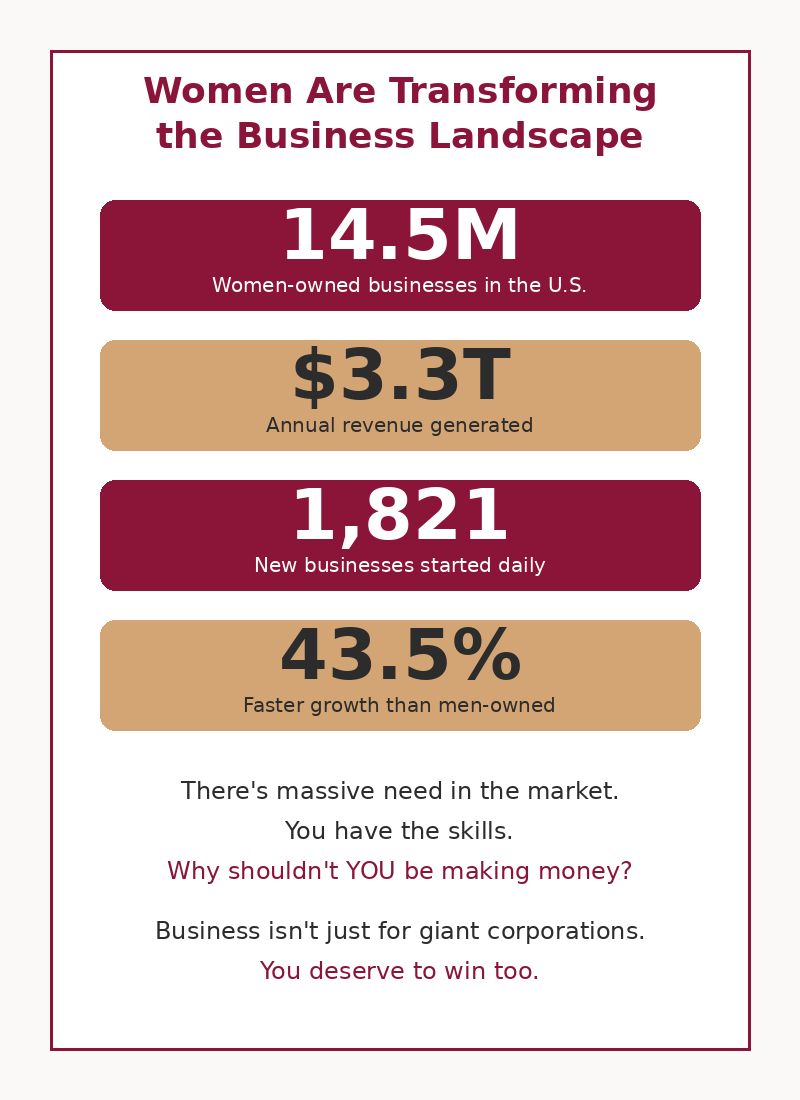
Women are starting businesses at an unprecedented rate. There are 14.5 million women owned businesses in the U.S. generating $3.3 trillion in annual revenue. Every single day, 1,821 new women owned businesses launch. And women owned businesses are growing 43.5% faster than those owned by men.
This isn't a trend. This is a transformation.
There's massive need in the market. You have skills someone is willing to pay for. Why shouldn't you be making money from them?
Business isn't just for giant corporations to succeed. The solo entrepreneur, the side hustler, the woman building something from her kitchen table? You deserve to win too.
The opportunity is there. The infrastructure exists. The market is hungry for what you can offer.
The only question is whether you're going to step up and claim your piece of it.
The Expensive Education Nobody Warns You About
Here's something I wish someone had told me before I started: you are going to waste money. A lot of it.
I've paid for:
- → Platforms I used for two weeks before realizing they didn't do what I needed
- → Apps that promised "one-click automation" and required ten steps and three support tickets
- → Courses that taught me things I could have learned from YouTube for free
- → Tools with beautiful interfaces that barely functioned
- → "All-in-one" solutions that were actually "half-baked-in-one"
I've spent literal thousands of dollars figuring out what works. I've rebuilt websites because I chose the wrong platform. I've migrated email lists because the first system couldn't scale. I've switched payment processors, inventory management systems, and analytics tools more times than I want to admit.
And every single one of those failures taught me something valuable.
The problem is, most people starting out don't have thousands of dollars to waste on trial and error. They need to get it right faster. They need someone who's already tested the tools, compared the platforms, and figured out what actually delivers on its promises.
That's the real mission behind Women Who Launch. I don't want my mistakes to be in vain. I don't want other women spending their limited resources on the same dead ends I hit. If I can save someone six months and $2,000 by telling them "don't use that platform, use this one instead", that alone makes everything I do worth it.
Working smarter isn't about cutting corners. It's about learning from people who've already done it wrong so you can do it right the first time.
I occasionally share affiliate links for tools, resources, or products I genuinely believe in. If you decide to purchase through one of these links, it helps support my work and our shared mission to reimagine wellbeing—thank you for being part of it.
💛 Curious what tools, platforms, and products I actually use and love?
Take a peek at my favorite resources!
Want free visibility for your business?
Add it to the WWL Business Directory for free!
No strings attached.
Join Our Newsletter
We send out regular updates, hot finds, discounts and anything else we can find to make your life easier.